NuShake came out to our house and removed the old roof, installed the new roof with all the trim and the aluminum around the vents, and it looks brand new. They did it all in one day and did an excellent job. I highly recommend them.
Homeowner Guide • Roof Health
Attic Ventilation 101: Why It Matters for Your Roof
How balanced airflow keeps your roof cooler, drier, and longer-lasting — and why it matters even more in Central Valley heat.
Attic ventilation is the most overlooked part of a roof. You cannot see it from the street, and nobody brags about it. But after years of walking roofs across Northern California, I can tell you the homes with hot, stuffy attics wear out their shingles years early. The good news: ventilation is one of the simplest, cheapest things you can fix.
I'm Brian Espindola. I run NuShake Roofing out of Ripon and hold my own C-39 license CSLB #1142280. This guide explains, in plain terms, how attic airflow works, how to spot when yours is failing, and why it matters so much in our heat.
In this guide: 9 sections
- How Attic Ventilation Actually Works
- Why Balance Matters More Than Quantity
- Signs of Poor Attic Ventilation
- The Link to Heat, Moisture, and Roof Lifespan
- The Central Valley Heat Angle
- Can You Fix Ventilation Without a New Roof?
- Frequently Asked Questions
- Related Resources
- 4.5 stars across 107 Google reviews.
Quick Answer
Your attic needs balanced airflow: cool air in at the eaves (intake), hot air out at the top (exhaust). Aim for roughly equal intake and exhaust, about 1 square foot of vent for every 150 square feet of attic. Poor ventilation bakes your shingles, traps moisture, raises cooling bills, and can void your warranty.
How Attic Ventilation Actually Works
Hot air rises. That simple fact is the whole system. In a well-ventilated attic, cool air enters low through vents in the eaves and pushes the hot air up and out through vents near the peak. Air keeps moving on its own, no fan required.
This is called the stack effect. When it works, your attic stays close to the outdoor temperature. When it does not, heat and moisture pile up with nowhere to go.
Intake vents (the bottom)
Intake usually comes from soffit vents — the perforated panels under your eaves. They let cool, fresh air in at the lowest point of the attic. Without enough intake, exhaust vents have nothing to pull, and the whole system stalls.
Exhaust vents (the top)
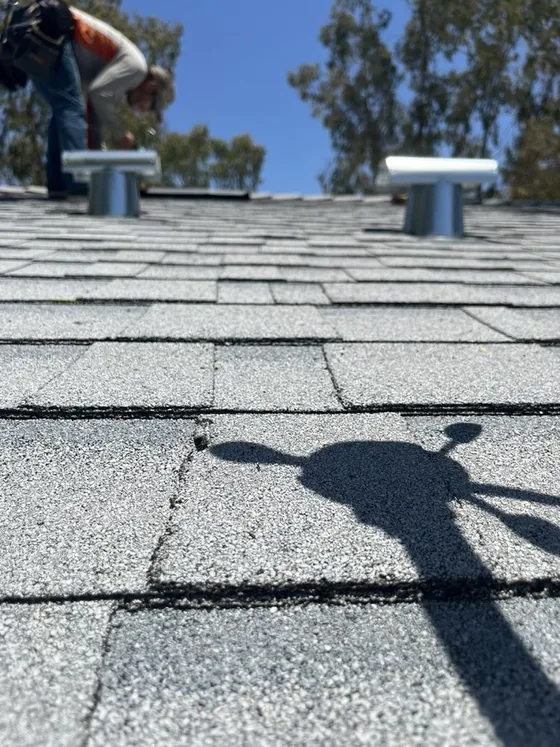
Exhaust sits near the ridge. The most common types are continuous ridge vents, static roof vents, and gable vents. They give the hot, rising air a way out. A continuous ridge vent paired with full soffit intake is the gold-standard setup for most homes.
Why Balance Matters
More Than Quantity
The single most common mistake I see is unbalanced ventilation. A home will have plenty of roof exhaust vents but blocked or missing soffit intake. With no air coming in low, the exhaust vents start pulling air from inside the house, or from each other — and almost nothing moves.
The rule of thumb: intake and exhaust should be roughly equal. If anything, lean slightly toward more intake. The standard target is 1 square foot of total net free vent area for every 150 square feet of attic floor, split evenly top and bottom.
More vents is not always better
Mixing too many exhaust types — say, a ridge vent plus powered fans plus gable vents — can short-circuit the airflow so air recirculates near the top instead of pulling from the soffits. A roofer plans one clean intake-to-exhaust path.
Signs of Poor Attic Ventilation
You do not need tools to catch most of these. Walk through this list:
- The attic feels like an oven on a hot afternoon.
- Upstairs rooms are always hotter than downstairs.
- Cooling bills keep climbing in summer.
- Shingles look curled, cracked, or soft before their time.
- The attic smells musty or you see mildew on the wood.
- Nail tips poking through the deck show rust — a moisture clue.
- Insulation in the eaves is packed against the roofline, blocking soffit vents.
Any one of these is worth a closer look. Several together mean your attic is fighting you.
The Link to Heat, Moisture,
and Roof Lifespan
Ventilation protects your roof from two enemies at once: heat and moisture.
Heat ages shingles from below
Asphalt shingles are rated for a certain lifespan under normal conditions. When an attic traps heat, the shingles cook from underneath. The asphalt dries out, granules loosen, and the roof ages faster than it should. In extreme cases, trapped heat can cut a shingle's real-world life by years.
Moisture rots the deck
Everyday living — showers, cooking, laundry — pushes warm, damp air upward. Without exhaust, that moisture condenses on cool attic surfaces in winter. Over time it rots the wood deck, ruins insulation, and breeds mold. A rotted deck is a far bigger repair than a new roof surface alone.
Warranties depend on it
Most shingle manufacturers require adequate ventilation to keep their warranty valid. If your roof fails early and the attic was under-ventilated, the manufacturer can deny the claim. Proper airflow is not optional — it is part of the system you paid for.
The Central Valley Heat Angle
Ventilation matters everywhere, but our climate makes it urgent. Central Valley summers routinely top 100 degrees. An under-ventilated attic on a hot day can hit 150 degrees or more — hotter than the air outside.
That heat does two things. It radiates down into your bedrooms, so your air conditioner runs harder and your bills climb. And it bakes the roof from below, all summer, every summer. A cooler attic means a cooler home, lower energy use, and a roof that lasts its full life.
This is also where ventilation and insulation team up. Insulation slows heat moving between the attic and your rooms. Ventilation clears the heat and moisture out of the attic itself. They solve different problems, and you want both done right. Our Title 24 attic insulation guide covers the insulation side in detail, and our insulation service can pair the two so they work together instead of against each other.
Climate Zone 12: what the energy code expects here
The Central Valley cities we serve — Ripon, Manteca, Lathrop, Stockton, Tracy, and Lodi — sit in California Climate Zone 12, one of the hotter-summer zones in the state's Title 24 energy code. In this zone the code leans hard on attic performance: strong attic insulation (Title 24 calls for R-49 when attic insulation is added or replaced) paired with balanced ventilation, and on many re-roofs a cool-roof or radiant-barrier measure. Ventilation is the airflow half of that equation. Our Title 24 attic insulation guide breaks down the R-value side in detail; this page is about moving the heat back out.
Cool-roof shingles and coatings — stopping heat at the surface
Ventilation clears heat that is already in the attic. A cool roof stops some of it from getting in. Reflective "cool-roof" shingles and, on flat or low-slope sections, a reflective roof coating bounce a share of the sun's energy off the roof instead of letting it soak into the deck. In Climate Zone 12 heat, a reflective surface up top plus balanced ventilation and adequate insulation is the combination that actually keeps a Valley attic — and the rooms under it — from turning into a furnace. Which measures make sense depends on your roof, and a free estimate is where we sort that out.
The winter version of the same problem
Summer heat is not the only season that tests a Valley attic. In winter, tule fog keeps roofs damp for days at a time, and the same poor ventilation that traps summer heat traps that winter moisture — leading to condensation, mold, and dry rot. If you are having the attic looked at for heat, it is worth checking the moisture side too. We cover it in what tule fog does to your Central Valley roof.
Can You Fix Ventilation Without a New Roof?
Often, yes. Many ventilation problems are standalone fixes:
| Problem | Typical Fix |
|---|---|
| Insulation blocking soffit vents | Install baffles to keep the airflow path open |
| Too few intake vents | Add or enlarge soffit vents |
| Not enough exhaust | Add static roof vents or gable vents |
| Aging roof with no ridge vent | Add a continuous ridge vent during re-roof |
Bigger upgrades, like a continuous ridge vent, are easiest to add during a roof replacement when the ridge is already open. But if your roof has years left, many fixes can be done on their own. The right move depends on what your roof needs — which is exactly what a free estimate tells you.
Frequently Asked Questions
Balanced ventilation means your attic has roughly equal intake at the eaves (soffit vents) and exhaust at the top (ridge or roof vents). Cool air enters low, warm air rises and exits high. The standard rule is one square foot of total vent area for every 150 square feet of attic floor, split evenly between intake and exhaust.
Common signs include an attic that feels like an oven in summer, high upstairs cooling bills, soft or curling shingles, a moisture or mildew smell in the attic, and rusted nail tips on the underside of the roof deck. Any of these means air is not moving the way it should.
Yes. Trapped heat bakes asphalt shingles from below, which dries out the asphalt and ages the roof faster than its rated lifespan. Trapped moisture rots the wood deck and can void shingle warranties. Most manufacturers require adequate ventilation to keep the warranty valid.
Central Valley summers regularly exceed 100 degrees, and an under-ventilated attic can reach 150 degrees or more. That heat radiates into living spaces and forces your air conditioner to run harder. Good ventilation lowers attic temperatures, cuts cooling costs, and protects the shingles from heat damage.
Often, yes. A roofer can add or unblock soffit vents, install additional roof or gable vents, and clear insulation that is choking the airflow path. Larger upgrades like a continuous ridge vent are usually done during a re-roof, but many ventilation fixes are standalone projects.
Yes. Insulation slows heat from passing between your attic and living space, while ventilation removes the heat and moisture that build up in the attic itself. They solve different problems. Insulation packed into the eaves can block soffit vents, so the two need to be installed with airflow in mind.
Yes. The Central Valley cities we serve — including Ripon, Manteca, Lathrop, Stockton, Tracy, and Lodi — fall in California Climate Zone 12, one of the hotter-summer zones under the state's Title 24 energy code. That zone is why attic insulation, balanced ventilation, and cool-roof measures matter so much here — they are what the code leans on to keep homes efficient in the heat.
They can. A reflective cool-roof shingle, or a reflective coating on a flat or low-slope section, bounces some of the sun's heat off the roof before it soaks into the deck and attic. Paired with balanced ventilation and good insulation, that lowers attic temperatures and cooling bills. Whether it is worth it depends on your roof and roof type — a free estimate is the way to find out.
Related Resources
What customers say
4.5 stars across 107 Google reviews.
NuShake did a beautiful job of installing my new roof. The amazing crew seemed to work non-stop and the roof turned out beautifully. My property was completely cleaned of any debris and I commend them all for doing a fantastic job.
The process from start to finish was excellent. Lindsey (office manager) and Sergio (estimator) respond quickly and efficiently to calls, emails, and texts. Edgar, Carlos, and Jose were very communicative when I had questions during the removal, dry rot repair, and installation of new roof.
Wondering if your attic is breathing right?
The owner or a senior crew lead will inspect your attic airflow and roof — free, no pressure, with a written estimate. We serve the Bay Area and north Central Valley from Ripon.
Or call Brian directly: (209) 253-0506