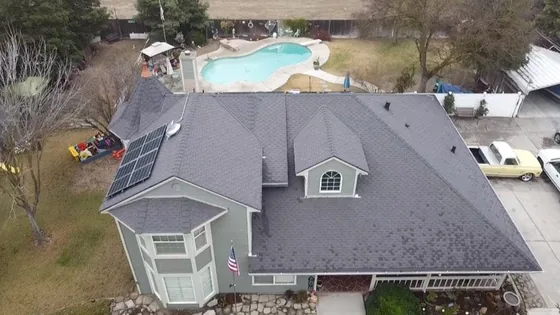
NuShake came out to our house and removed the old roof, installed the new roof with all the trim and the aluminum around the vents, and it looks brand new. They did it all in one day and did an excellent job. I highly recommend them.
Owner-operated by Brian Espindola • Licensed C-39 roofing contractor • CSLB #1142280
NEM 3.0 Solar: Is It Still Worth It in the Bay Area?
California changed the solar economics in April 2023. The old NEM 2.0 rules paid close to retail for exported power, so paybacks were much shorter. Those rules are gone for new installations. Under NEM 3.0 — California's 2023 rules for how rooftop solar is credited — utilities now pay about 75% less for power you export to the grid. That changes the math in a big way. It does not make solar a bad investment. But it does mean you need to understand the new rules before you sign anything.
GAF Solar Certified Installer
Free Estimate
NEM 3.0 Payback Math
In this guide: 11 sections
- Get a free solar estimate.
- 4.5 stars across 107 Google reviews.
- What NEM 3.0 Actually Changed — and When
- The Payback Math Under NEM 3.0
- Why Combining Roof and Solar Saves Real Money
- Why GAF Solar Certified Matters in the Bay Area
- Title 24 Cool-Roof Requirement — Solar Panels Help
- Bay Area Sun and Utility Differences — PG&E vs SMUD
- The Interconnection Process — Who Does What
- Frequently Asked Questions — NEM 3.0 and Bay Area Solar
- Related pages
Quick Answer
NEM 3.0 pays you about 75% less for the power you send back to the grid than the old NEM 2.0 rules did. So the smart move now is to use your own solar power instead of exporting it. Add a battery and most Bay Area homes pay off solar plus battery in about 13–20 years; the 30% federal tax credit ended for systems installed after 2025. The best savings come from doing your roof and solar in one project. You also avoid a $3,000–$6,000 bill later to pull panels off for a re-roof.
CSLB #1142280
Free consultations
Mon–Fri 8am–5pm · Sat 8am–12pm
Get a free solar estimate.
Takes 30 seconds. No obligation.
- Licensed — CSLB #1142280
- 5 manufacturer certifications — GAF, Owens Corning, CertainTeed
- Written quote — before any work
- No high-pressure sales — ever
What customers say
4.5 stars across 107 Google reviews.
NuShake did a beautiful job of installing my new roof. The amazing crew seemed to work non-stop and the roof turned out beautifully. My property was completely cleaned of any debris and I commend them all for doing a fantastic job.
The process from start to finish was excellent. Lindsey (office manager) and Sergio (estimator) respond quickly and efficiently to calls, emails, and texts. Edgar, Carlos, and Jose were very communicative when I had questions during the removal, dry rot repair, and installation of new roof.
What NEM 3.0 Actually Changed — and When
California's Public Utilities Commission issued Decision 22-12-056 in December 2022. The new NEM 3.0 tariff became effective for new solar applicants on April 15, 2023.
Here is the core change. Under NEM 2.0, you received roughly the full retail rate for electricity you sent back to the grid. That was around $0.25–$0.35/kWh for PG&E customers at the time. Under NEM 3.0, the export rate dropped to roughly $0.02–$0.05/kWh. That is about 75% less.
To be clear, power you use yourself — straight from your solar panels during the day — still saves you the full retail rate. PG&E's time-of-use rates run $0.30–$0.50/kWh during peak hours. So using your own power at $0.45/kWh, instead of exporting it at $0.03/kWh, is a 15x difference. That gap is the whole point of NEM 3.0: use more of your own power, send less to the grid.
Who is grandfathered under NEM 2.0?
Interconnection means hooking your solar up to the grid. If your system was interconnected under NEM 2.0 before the April 15, 2023 deadline, you keep NEM 2.0 rates for 20 years from that date. You may also qualify if you submitted a complete interconnection application to PG&E before the cutoff. That depends on when PG&E processed it.
New applicants — anyone applying for solar interconnection after April 15, 2023 — are under NEM 3.0. That covers most Bay Area homeowners starting solar today.
The Payback Math Under NEM 3.0
Let's work through a real example for a Bay Area household.
Assumptions
- 7 kW solar system.
- Bay Area location (Pleasanton, Livermore, or similar East Bay / Tri-Valley).
- PG&E service territory, E-TOU-C rate schedule.
- Annual electricity cost before solar: $2,400.
- System produces roughly 10,500 kWh per year.
- System cost: $25,000 (solar only, assuming roof is already in good shape).
- Federal solar tax credit: none (ended for systems placed in service after December 31, 2025).
- Net cost: $25,000.
Without a battery — export-heavy scenario
Say you are away during the day, so most of your solar exports to the grid. You receive $0.03/kWh for that exported power. Then you buy grid power in the evening at $0.45/kWh. Net annual savings fall to roughly $1,000–$1,500. Payback: 17–25 years.
With a battery — self-consumption optimized
A 13.5 kWh battery stores midday excess and discharges it during the evening peak. Your self-consumption rate jumps from perhaps 30% to 70–85%. Annual savings rise to $2,000–$2,800. Payback on the solar portion (before battery cost): 9–13 years.
Adding a 13.5 kWh battery costs roughly $10,000–$15,000 installed. There is no federal credit to offset it. Combined project cost: $35,000–$40,000. Combined payback with battery: 13–20 years for most Bay Area homes.
The NEM 2.0 comparison
Under NEM 2.0, the same 7 kW system would have saved roughly $2,000–$2,600 a year even with heavy export, because export rates matched retail rates. At today's $25,000 price with no credit, that is a 10–13 year payback, against 17–25 years now without a battery. That era is over for new installations. Solar plus battery under NEM 3.0 is a longer-term investment now: with the 30% federal credit gone, the payback runs longer, though rising electricity rates shorten it.
Why Combining Roof and Solar Saves Real Money
Panels mounted on whatever roof is there cause problems when that roof wears out. NuShake is a roofing contractor with a GAF Solar Certified Installer credential, so the roof under your solar is planned for it.
Roofing license, electrical license
Panel wiring, batteries and the utility hookup are electrical work that needs a C-46 (solar) or C-10 (electrical) license; NuShake's license, CSLB #1142280, is C-39 roofing. At your estimate we tell you who does the electrical side of your project.
No panel removal cost later
If you put solar on a roof with 8 years of life left, you will eventually pay $3,000–$6,000 to have panels removed, the roof replaced, and panels put back. Do both now and that cost disappears entirely. NuShake's free estimate tells you your roof's actual remaining life before we recommend any solar timeline.
Flashing set while the roof is open
Solar mounts need flashed penetrations. On a re-roof we set the solar-ready flashing while the roof is open, instead of cutting into a finished roof later.
Itemized cost records
The 30% federal residential solar credit is not available for systems placed in service after December 31, 2025, so combining the jobs no longer earns a larger credit. NuShake gives you an itemized cost record for the roof work. Your tax advisor decides whether anything else applies.
Why GAF Solar Certified Matters in the Bay Area
GAF Energy's Timberline Solar is the only integrated solar shingle system with a true manufacturer's roofing warranty. That is because GAF makes both the shingles and the solar cells. The system lies flat against the roof and looks like regular shingles from the street. There are no racks drilled into the roof, so there are no rack holes to leak.
Here is the catch: only GAF Solar Certified Installers can install Timberline Solar. GAF requires specific training and audited project documentation before granting certification.
NuShake holds GAF Solar Certified Installer status alongside our GAF Master Elite, GAF Gold Elite, CertainTeed Select ShingleMaster, and Owens Corning Preferred credentials.
If you want conventional panel-compatible roofing, NuShake handles that too — every option is covered. But if you are interested in integrated solar shingles and want a contractor authorized to install them, you have a short list. Brian is on it.
Title 24 Cool-Roof Requirement — Solar Panels Help
California's Title 24 energy code requires cool-roof-compliant products on most re-roofing projects. Cool roofs reflect more solar energy and reduce heat gain — they carry a CRRC (Cool Roof Rating Council) rating for solar reflectance and thermal emittance.
Solar panels that cover a large part of the roof meet the cool-roof requirement for the covered area. Covered roof does not gain heat the same way an exposed roof does. For the uncovered areas, NuShake uses Title 24-compliant shingles or membrane as standard. On a combined project, this usually makes Title 24 compliance simple — no special exemptions or calculations needed. For more on this, see our Title 24 attic insulation guide. A panel-covered roof also runs cooler when the attic beneath it breathes properly. Our attic ventilation guide explains why airflow protects both the roof and the panels above it.
Bay Area Sun and Utility Differences — PG&E vs SMUD
Bay Area solar production varies significantly by microclimate. The Tri-Valley — Pleasanton, Livermore, Dublin — gets 250–270 sunny days per year and averages about 5.5 peak sun hours. Closer to the coast or in the fog belt (San Francisco, Daly City), that drops to 4.0–4.5 peak hours. More sun means more production, faster payback.
Utility territory matters too. Most of our Bay Area service area falls under PG&E (Pleasanton, Livermore, Stockton). Customers closer to Sacramento — particularly Sacramento proper and Elk Grove — may be in SMUD territory. SMUD runs its own net metering rules, which are currently more favorable than PG&E's NEM 3.0. So if your property is in SMUD territory, the payback timeline can be noticeably shorter. Brian confirms which utility serves your address at the start of every consultation.
The Interconnection Process — Who Does What
PG&E's interconnection process (the steps to hook your solar up to the grid) has several stages, each on its own timeline. It runs through the building permit, the utility's Rule 21 application, the install, and the final city inspection. The last step is PG&E's Permission to Operate, or PTO — the green light to switch the system on. Each one is a separate milestone.
NuShake pulls the roofing permit and sets the solar-ready flashing. Panel wiring, batteries and the utility hookup are electrical work that needs a C-46 (solar) or C-10 (electrical) license; NuShake's license, CSLB #1142280, is C-39 roofing. At your estimate we tell you who does the electrical side of your project. The interconnection window after installation typically runs 4–8 weeks on PG&E's end — that is normal and outside anyone's control.
Related services in our territory: solar roofing hub, Pleasanton roofing, Tracy roofing, Discovery Bay roofing.
Frequently Asked Questions — NEM 3.0 and Bay Area Solar
California's PUC replaced NEM 2.0 with NEM 3.0 on April 15, 2023 for new applicants. Utilities now pay roughly $0.02–$0.05/kWh for exported solar power — about 75% less than under NEM 2.0. Power you use yourself still saves the full retail rate. NEM 2.0 customers are grandfathered for 20 years from their interconnection date.
For an export-heavy system without battery, expect roughly 17–25 years now that the 30% federal credit has ended. The exact figure depends on your rate schedule, roof orientation, and daytime self-consumption. Homes with heavy daytime usage (home offices, EV charging during the day) may land closer to 14 years.
A battery shifts midday solar from export-at-$0.03 to self-consume-at-$0.50 during evening peak hours. That shift brings most Bay Area households to a 13–20 year payback on solar plus battery, now that the 30% federal credit has ended for new systems.
Most Bay Area homes pair a 7–10 kW solar system with a 10–20 kWh battery (one to two units). A single 13.5 kWh unit covers average evening loads. EV charging or backup-power requirements push toward two units. Brian reviews your usage data and rate schedule before making a sizing recommendation.
Partial shading reduces output but microinverters or DC optimizers limit the penalty to only the shaded panels. If you have good southern or western exposure on part of the roof, solar can still make financial sense. NuShake's free estimate includes a roof-orientation and shading assessment before sizing anything.
Yes, but expansion is easier if planned for upfront. A panel-compatible roofing system designed with future expansion costs little extra today. Adding panels later requires a new permit, additional interconnection paperwork, and possibly a new inverter. If you plan to add an EV or pool, size for that from the start.
NEM 3.0 applies to PG&E, SCE, and SDG&E — the three CPUC-regulated utilities. SMUD (Sacramento area) sets its own rules and generally offers more favorable export rates. Brian confirms which utility serves your address at the first consultation.
Panel wiring, batteries and the utility hookup are electrical work that needs a C-46 (solar) or C-10 (electrical) license; NuShake's license, CSLB #1142280, is C-39 roofing. At your estimate we tell you who does the electrical side of your project. The interconnection process typically takes 4–8 weeks on PG&E's end after installation.
Yes. Removing and reinstalling a standard array runs $3,000–$6,000 for most Bay Area homes. Integrated solar shingles cost more to work around. If your roof has less than 10–15 years of life remaining, doing both at once eliminates that future cost entirely. NuShake's free estimate tells you the roof's remaining life before any solar recommendation.
Not for new systems. The federal residential clean energy credit (IRS Form 5695) is not available for systems placed in service after December 31, 2025. Systems placed in service by then are claimed on a 2025 tax return. NuShake provides itemized cost documentation, and your tax advisor determines whether anything else applies.
Related pages
Ready to see the numbers for your home?
Brian walks through NEM 3.0 math on your specific address — PG&E rate schedule, roof orientation, self-consumption estimate, and payback. Free, no obligation.
Brian Espindola · Owner · CSLB #1142280 · GAF Solar Certified Installer