This was the second house I have had re-roofed by NuShake and each time they have exceeded my expectations. The office staff is amazing and the workers are so professional. My roof looks amazing, they were clean and communicated well with me every step of the way. Couldn’t be happier.
Cost Guide • 2026
Roof Replacement Cost by Material (Bay Area)
Installed price ranges per material for a typical Bay Area home — plus the tear-off, permit, decking, and underlayment factors that move your final number.
In this guide: 9 sections
- Installed Cost by Material
- A Worked Cost Example for Each Material
- Why Asphalt Costs Less and Metal Costs More
- Where the Money Goes: Labor vs. Materials
- What Drives Your Final Cost
- Start With an Inspection, Not a Phone Estimate
- Frequently Asked Questions
- Related Resources
- 4.5 stars across 107 Google reviews.
Quick answer
For a typical 1,500–2,200 sq ft Bay Area home in 2026: asphalt shingle runs about $11,000–$35,000, tile $22,000–$45,000, standing seam metal $28,000–$55,000, roof-plus-solar $35,000–$70,000+, and flat TPO $14,000–$35,000 by size. These are estimates, not quotes. Your real price depends on roof size, pitch, tear-off layers, decking condition, and your city's permit fees.
What this page covers: installed price ranges by material. For project budgeting and financing, see how much a new roof costs in the Bay Area.
Cost is the first question most homeowners ask. It is a fair one. This guide gives you honest 2026 installed price ranges by material for the Bay Area, then explains the factors that push your number up or down. The goal is simple: help you read a quote and know it is fair.
I'm Brian Espindola. I run NuShake Roofing from Ripon and hold my own C-39 license CSLB #1142280. I price jobs across the Bay Area every week. Here is what your money actually buys.
Installed Cost by Material
These ranges assume a full tear-off on a usual home with low-to-moderate pitch. Steep roofs, complex valleys, and many roof planes add labor and cost. Figures reflect Bay Area labor, materials, and permits as of May 2026. They are estimates — a real quote needs an inspection.
| Material | Tier | Typical installed cost (1,500–2,200 sq ft) |
|---|---|---|
| Asphalt 3-tab | Entry | $11,000–$15,000 |
| Architectural asphalt (OC Duration, GAF Timberline HDZ) | Mid — most common | $14,000–$26,000 |
| Premium designer asphalt (GAF Camelot II) | Premium asphalt | $22,000–$35,000 |
| Concrete tile | Premium | $22,000–$38,000 |
| Clay tile | Premium | $28,000–$45,000 |
| Standing seam metal | Longevity | $28,000–$55,000 |
| Roof + solar (combined project) | High-end | $35,000–$70,000+ |
| Flat (TPO membrane) | Flat / low-slope | $14,000–$35,000 (size-dependent) |
Want to compare the materials beyond price — lifespan, weight, fire rating, and climate fit? Read our pillar guide on Bay Area roofing materials compared.
A Worked Cost Example
for Each Material
Here is how those ranges get built. Picture one house: a roughly 1,900 sq ft single-story Bay Area home, single-layer tear-off, low-to-moderate pitch, with a few sheets of decking replaced. This is an illustrative estimate, not a quote. A steep or complex roof runs higher. The same house, walked material by material, shows where the spread comes from.
Architectural asphalt — the most common choice
This is the mid tier above, landing in the $14,000–$26,000 band. The roof system itself is the bulk of the cost. Single-layer tear-off is included. Add a few sheets of decking at the on-page $85–$130 per sheet, drip edge at $300–$700, ice-and-water shield at $300–$600, and a city permit from $150 to $900. On this house, the total settles around the middle of that band.
Concrete or clay tile — premium and heavier
Tile lands higher: concrete in the $22,000–$38,000 band, clay in the $28,000–$45,000 band. The same decking, drip edge, shield, and permit lines apply. Tile is heavier, so tear-off and disposal cost more. The install is slower and needs more skill. Both push the total above asphalt on the same house.
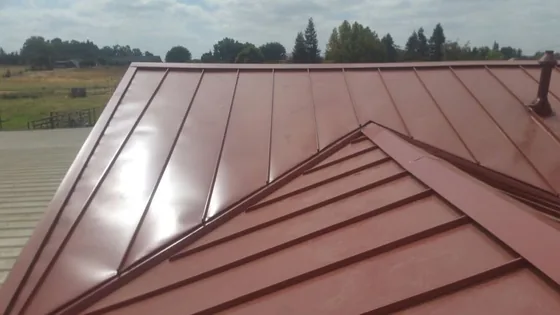
Standing seam metal — longevity tier
Metal lands in the $28,000–$55,000 band. The material costs more per square than asphalt. The install needs certified, skilled hands, so labor climbs too. With both buckets up, a metal roof on this house runs roughly double the architectural-asphalt example above.
Flat / low-slope (TPO) — size-driven
Flat roofing lands in the $14,000–$35,000 band. Flat sections are priced by the square footage of low-slope area. A small flat section over a porch sits low in the band. A whole flat roof sits high. Size drives this one more than anything else.
Same house, four very different totals
The spread is labor and material, not markup. A heavier or more skilled material climbs in both buckets at once. Your real number needs an on-site look — get a free, no-pressure estimate below.
Why Asphalt Costs Less and Metal Costs More
Material price is only part of the story. Labor and install time drive a lot of the gap. Asphalt goes on fast with a standard crew. Tile is heavy and slow. Metal needs skilled, certified hands. Solar adds an electrical scope on top of the roof. Each step adds labor hours, and labor is the largest line on most Bay Area quotes.
For the full breakdown of each material's strengths, see the roof replacement service page or the dedicated tile, metal, solar, and flat roofing pages.
Where the Money Goes: Labor vs. Materials
A Bay Area re-roof quote splits into four buckets. Labor is the crew's install time. Materials are the roof system itself. Tear-off and disposal cover the dump fees plus the hours to strip the old roof. Accessories and permits cover underlayment, drip edge, shield, and the city fee. Labor is usually the single largest bucket here, because Bay Area crew rates run 30 to 40 percent higher than the Central Valley.
| Cost bucket | What it covers | Relative share |
|---|---|---|
| Labor & install | Crew time to strip and lay the new roof | Largest share — grows with pitch, complexity, and material difficulty |
| Materials (the roof system) | Shingles, tile, or panels and their fasteners | Second-largest — rises sharply from asphalt to tile or metal |
| Tear-off & disposal | Removing old layers and hauling them to the dump | Moderate — more layers and heavier material (tile) cost more to remove |
| Accessories & permits | Underlayment, drip edge, shield, and the city permit | Smaller but unavoidable |
The labor-to-material mix shifts by material. Asphalt is material-light and fast, so it is labor-dominated but low in total. Tile and metal carry a pricier material and a slower, more skilled install. Both buckets climb together. That is why a metal roof can cost roughly double an architectural-asphalt roof on the same house — compare the $14,000–$26,000 asphalt band to the $28,000–$55,000 metal band in the table above.
The cheapest bid is rarely the best
A low number usually means a thinner labor allowance or a skipped accessory, not a better deal.
What Drives Your Final Cost
Two identical-looking homes can get very different quotes. Here is what moves the number.
Roof Size and Pitch
More square footage means more material and labor. A steep roof is slower and riskier to work, so it costs more per square than a walkable, low-slope roof. Crews need extra safety gear and time on steep pitches.
Tear-Off and Disposal
Removing the old roof is real labor plus dump fees. One old layer costs less to remove than two or three stacked layers. Heavy materials like tile cost more to tear off and haul away. We list tear-off scope in writing so you know exactly what is included.
Decking Condition
You cannot see the wood deck until the old roof is off. Bay Area damp — especially near the delta and coast — rots plywood and OSB over time. Soft or rotted sheets must be replaced. A fair contractor sets a per-sheet rate up front, typically $85–$130 per sheet in the Bay Area, rather than hiding it.
Underlayment, Drip Edge, and Shield
These layers sit under your shingles and protect your home. Synthetic underlayment costs more than old felt but performs better. Drip edge ($300–$700) is required by code and warranty. Ice-and-water shield at the eaves ($300–$600 on a typical roof) is required by many Bay Area cities. A good quote lists each item.
Permits
Every Bay Area city and county requires a roofing permit for a full replacement. Fees range from about $150 to $900 depending on the city. Pleasanton and Walnut Creek sit near the top. A reputable contractor pulls the permit and builds the fee into the quote.
Budget rule of thumb
Add 10–15% to any base quote to cover decking, drip edge, and shield. A contractor who prices these up front is helping you, even when the number looks higher on day one. The surprise charges come from the bids that leave them out.
How to budget and compare quotes?
City permit fees, financing, and reading bids fairly live on our budgeting guide. See how much a new roof costs in the Bay Area.
Start With an Inspection,
Not a Phone Estimate
A real number needs eyes on your roof. A free roof estimate lets us measure your roof, check the decking access, count the existing layers, and confirm your city's permit cost. Then you get a written estimate you can trust — not a guess over the phone.
Frequently Asked Questions
For a typical 1,500 to 2,200 sq ft Bay Area home in 2026, asphalt shingle runs about $11,000 to $35,000, tile $22,000 to $45,000, standing seam metal $28,000 to $55,000, and a roof-plus-solar project $35,000 to $70,000 or more. Flat TPO sections run $14,000 to $35,000 by size. These are estimates, not quotes.
The biggest cost drivers are the material you choose, your roof's size and pitch, how many old layers must be torn off, the condition of the decking underneath, and local permit fees. Bay Area labor also runs 30 to 40 percent higher than the Central Valley, which lifts every quote in the region.
Yes. Tear-off and disposal are real labor and dump costs. The price grows with each old layer that must come off. A single-layer tear-off costs less than removing two or three layers. We always include tear-off scope in writing so there is no surprise on invoice day.
You cannot see decking damage until the old roof is off. Rot or soft plywood must be replaced for the new roof to hold. Honest contractors quote a per-sheet rate up front — typically $85 to $130 per sheet in the Bay Area — instead of hiding it in a vague total.
They add real money. Bay Area roofing permits range from about $150 to $900 by city. Synthetic underlayment, drip edge, and ice-and-water shield are code or warranty items that add a few hundred to over a thousand dollars. A good quote lists these clearly rather than burying them.
Often not. A low quote frequently leaves out decking, drip edge, shield, or a real warranty. Those gaps reappear as change orders on invoice day. Compare the full written scope — material brand, underlayment, decking policy, and warranty — not just the bottom-line number.
Related Resources
What customers say
4.5 stars across 107 Google reviews.
During a heavy rainstorm, discovered the roof was leaking badly. It was impossible to find a roofing contractor. My neighbors recommended someone who was non-responsive. The pro desk at Home Depot recommended NuShake. They were very responsive, came out within a couple of days, arranged the work quickly, did it reasonably and professionally and were a pleasure to work with.
These people are the best of the best. I am very critical and picky when it comes to having work done at my home, letting strangers in, etc. This group blew me away. It’s a multi-step process, and the salesperson, the 5–6 crew members who worked on it, the office staff — all were upbeat, smart, friendly, respectful. They made it fun even.
Get a written, no-pressure estimate
The owner or a senior crew lead will inspect your roof, explain your material options, and give you an honest written number. We serve Pleasanton, Livermore, Stockton, and 20+ cities across the Bay Area and north Central Valley.
Or call Brian directly: (209) 253-0506